The other day, I got a press release in which the first sentence read: “According to a new study just published in ADSA’s (American Dairy Science Association) Journal of Dairy Science, organic milk has no nutritional advantage when compared with conventional milk.”
I could just see the headlines. “Organic Milk: Why Bother?”
So I decided to investigate the study. Turns out, it has little to do with nutrition, and its findings are unclear. Even its title is confusing: “Survey of the fatty acid composition of retail milk differing in label claims based on production management practices.” (Journal of Dairy Science 93: 1918-1925).
Huh? The study in a nutshell: The researchers tested 292 random samples of three different kinds of milk: conventionally produced milk, milk labeled “rbST-free,” and milk labeled “organic.” They measured for levels of fatty acids, and found that the FA levels in all three kinds of milk were virtually the same.
How you get from that finding to the conclusion that “Organic milk has no nutritional advantage” is totally beyond me.
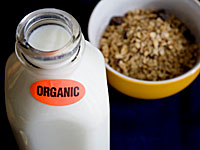
Getty Images
What’s rbST and do we want this stuff in our milk?
In conventional dairy farms, cows can be treated with something called recombinant bovine somatotropin, or rbST for short. It’s a genetically engineered version of a naturally occurring hormone that stimulates milk production. It’s injected into dairy cows to make them produce more milk, and doing so increases the cows’ risk for the painful inflammation called mastitis, among other health problems. The treatment for mastitis is antibiotics, including penicillin (10% of us, including me, are allergic to penicillin). Recently, a team of distinguished doctors concluded that treating mastitis with antibiotics increases antibiotic resistance that can be transferred to humans—which, they said, is “an extremely dangerous, and growing, problem.” Antibiotic resistance is the reason dangerous, even lethal, bacterial infections like MRSA are so scary—the bacteria don’t respond to traditional antibiotic treatments.
In conventional dairy farms, cows can be treated with something called recombinant bovine somatotropin, or rbST for short. It’s a genetically engineered version of a naturally occurring hormone that stimulates milk production. It’s injected into dairy cows to make them produce more milk, and doing so increases the cows’ risk for the painful inflammation called mastitis, among other health problems. The treatment for mastitis is antibiotics, including penicillin (10% of us, including me, are allergic to penicillin). Recently, a team of distinguished doctors concluded that treating mastitis with antibiotics increases antibiotic resistance that can be transferred to humans—which, they said, is “an extremely dangerous, and growing, problem.” Antibiotic resistance is the reason dangerous, even lethal, bacterial infections like MRSA are so scary—the bacteria don’t respond to traditional antibiotic treatments.
And there’s another potential health risk from having rbST in our milk supply. Some researchers believe it increases human levels of insulin-like growth factor-1 (IGF-1), which is linked in some studies to increased rates of certain cancers, including cancers of the colon, breast, and prostate.
At this point, I should probably mention that Monsanto developed rbST, and helped fund the Journal of Dairy Science nutrition study. And I should also point out that Canada, the European Union, Australia, and New Zealand ban its use.


No comments:
Post a Comment